Fedora-vs-arch
Architectural Security Analysis: Fedora vs. Arch Linux
Theme: Immunity is a Myth—The Real Metric is Containment, Downstream Validation, and Structural Resiliency. Date: June 15 2026
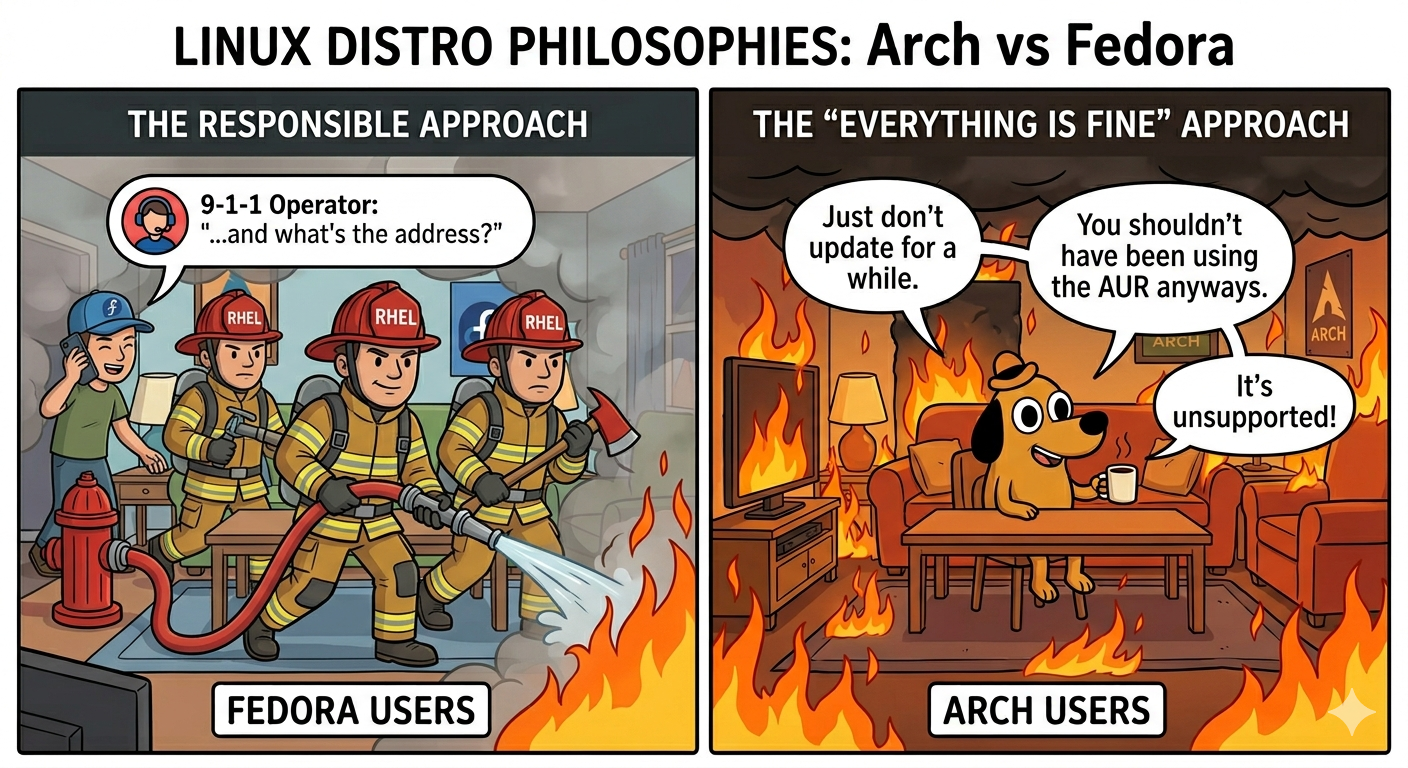
1. Executive Summary
A common misconception in the open-source community is that certain Linux distributions are inherently immune to compromise due to code transparency or packaging models. Recent concurrent security incidents across Fedora and Arch Linux prove the contrary: as Linux gains widespread global adoption, it becomes a high-priority target for sophisticated, automated malicious campaigns.
The core differentiator is not the impenetrability of the operating system, but rather the downstream checks and balances and the governance structure available to isolate and remediate a breach before it reaches the end user.
2. Incident Case Studies
Case A: Fedora (The "Agentic AI" Bugzilla Hijack)
- The Vector: Stolen developer credentials via an upstream phishing campaign.
- The Mechanism: An automated, autonomous "Agentic LLM" script was hooked up to the compromised account, executing rapid-fire, erratic administrative actions inside Red Hat Bugzilla (RHBZ).
- The Behavior: Mass-reassigning bugs to the hijacked account, generating hallucinated code fixes, and closing active bugs downstream before they were stabilized.
- The Firewall: Because Fedora utilizes strict isolation between its issue trackers and its actual package build pipelines, the exploit was completely contained at the bureaucratic level. It possessed zero capacity to inject malicious code into production binaries or flow downstream to enterprise-grade derivatives.
Case B: Arch Linux (The "Atomic Arch" Supply Chain Escalation)
- The Vector: Coordinated, automated exploitation of uncurated repository trust mechanics.
- The Mechanism: Attackers used automated scripts to claim "orphaned" (abandoned) packages within the Arch User Repository (AUR), inheriting the trust metrics and names of older, legitimate software.
- The Real-Time Escalation:
- Evolving Tactics: The campaign has expanded aggressively, growing from a few hundred flagged packages to nearly 1,500 affected packages.
- Filter Evasion: When the community deployed scanners to flag the initial malicious Node dependencies (
atomic-lockfile), the attackers immediately pivoted to Bun-based installation paths and alternative rogue modules (js-digest,lockfile-js) to bypass static detection. - Advanced Payload: The attack drops a compiled binary that utilizes eBPF (Extended Berkeley Packet Filter) techniques to mask its active processes. It hooks directly into the kernel to hide itself from standard user-space monitoring tools like
psandhtop, making manual identification almost impossible for infected users.
3. Comparative Response & Pipeline Analysis
| Metric | Fedora (Corporate-Backed Ecosystem) | Arch Linux (Decentralized Community) |
|---|---|---|
| Primary Target | Centralized tracking infrastructure (Bugzilla) | Sandboxed user-maintained ecosystem (AUR) |
| Response Type | Top-down, hierarchical containment | Crowdsourced, distributed "whack-a-mole" |
| Downstream Protection | Absolute. Multiple layers of human and automated gating prevent administrative errors from touching stable packages, completely insulating enterprise downstream distros (RHEL, Alma, Rocky). | None. Once a malicious package update is pushed to the AUR, it is pulled directly to user machines upon their next manual system update. |
| Remediation Action | Core QA leads locked the account and globally rolled back database changes within hours. | Trusted Users (TUs) frozen new accounts and manually audited 1,500+ shifting package commits as the threat evolved. |
| End-User Defense | Passive/Zero Burden. The platform infrastructure absorbed the shock seamlessly. | Active/High Burden. The user's only line of defense is manually checking web advisories, reading the news, and auditing every line of a PKGBUILD before updating. |
4. Operational Realities: Production vs. Enthusiast Distros
The Enterprise Shield
Fedora is explicitly designed to be an innovative, fast-moving upstream pipeline for enterprise Linux. While it pushes the envelope by experimenting with cutting-edge tech stacks (such as integrated AI developer environments), it is tethered to a corporate framework. The infrastructure is built on the assumption that endpoints will be compromised. Because the system does not grant automated trust to individual developer flags, the breach was handled at the gates.
The Failure of the "Wild West" Trust Model
The ongoing escalation of the "Atomic Arch" campaign proves that the classic, uncurated, crowdsourced software repository model is an active liability in a modern threat landscape. The AUR operates on a legacy paradigm of mutual goodwill and manual user vigilance. In an era where automated scripts can hijack 1,500 packages instantly and deploy kernel-level eBPF rootkits, a distribution that requires its users to act as full-time code auditors just to run routine updates ceases to be a viable environment for serious work.
Conclusion for System Architecture
For critical infrastructure, professional workstations, or when recommending an operating system to users who need a tool rather than a second hobby, the distribution must absorb infrastructure shocks on behalf of the user.
Fedora demonstrated the organizational and structural resilience required to survive a modern automated attack with zero consumer impact. Arch demonstrated that total individual freedom creates total individual liability—an unsustainable operational cost for production environments.